 September 21, 2026 "Evaluating Forward Facing Sonar Impacts on Minnesota Fish"
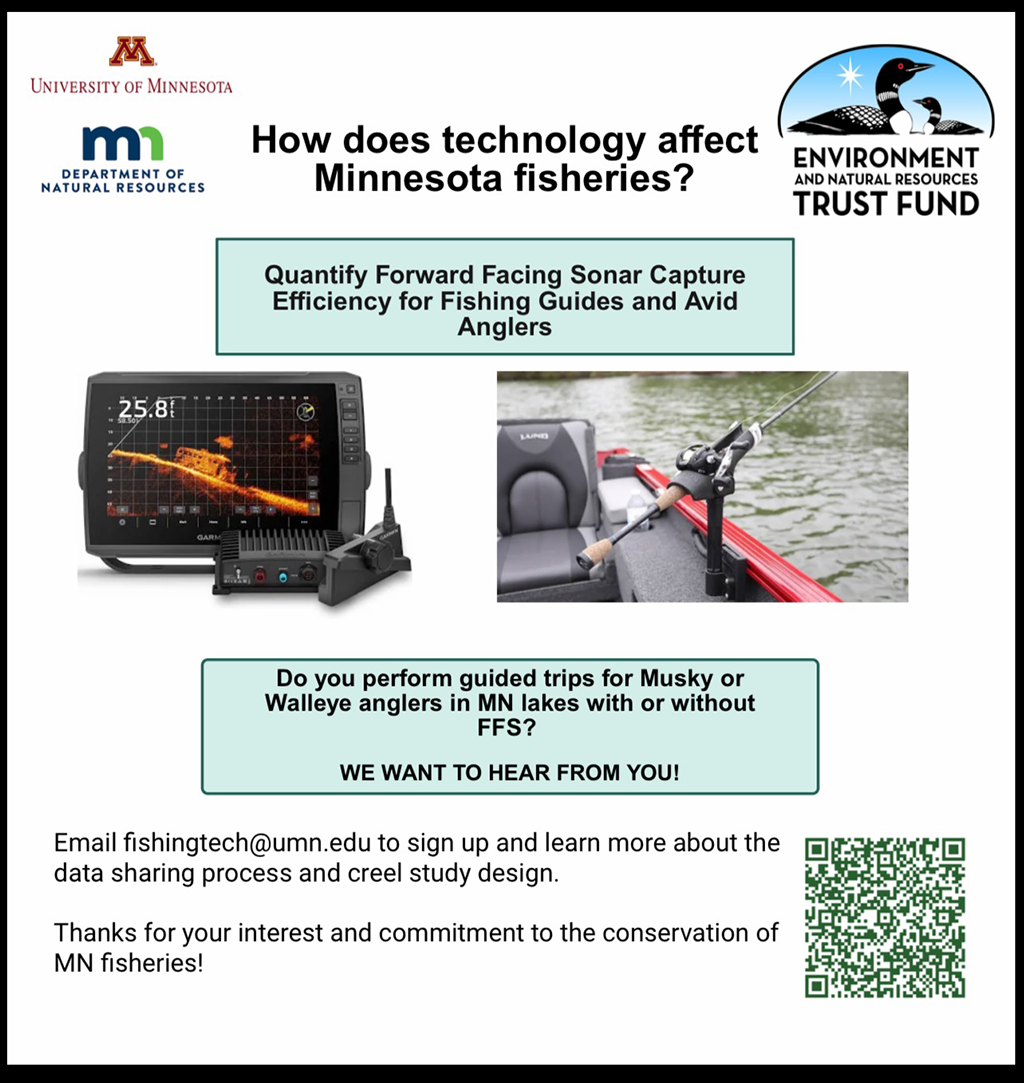 Fisheries managers struggle to decide whether advanced electronics and other technologies should, or should not, be regulated. To assist them, the University of Minnesota, in conjunction with the Minnesota Department of Natural Resources and the LCCMR have initiated a formal study about fishing electronics and the use of them.
The study, "Evaluating forward-facing sonar impacts on Minnesota fish", is aimed at fishing guides, tournament pros and avid anglers who fish for either walleyes, or muskies in the state of Minnesota. Cam Mosley, researcher and co-organizer of the project, has reached out to me, along with other fishing professionals for help. I’ve already volunteered to sign up as a contributor, and now, I’m asking you, or your favorite fishing pros, to do the same.
What is involved for guides and avid anglers will be to document our daily fish catches and report the results to the research team at the U of M. As they compile data, results will be used to assess and determine the impact of technologies on fish populations. These assessments will then be used to make decisions about what, if anything can or should be done to “manage” the use of the technology.
If you are an avid angler, hire fishing guides to take you fishing, or have friends who do, please help us out by passing along this link. Tournament anglers too should consider giving back to the sport by providing details about daily catches.
To participate in the study, use this link >> Evaluating Forward Facing Sonar Impacts on Minnesota Fish or scan the QR code to sign up. For more information, or to ask questions, contact >> Cam Mosley
To weigh in with your opinions or share your own research, feel free to contact me directly.  — Office Call or Text 218-245-9858 or EMAIL on Facebook on X
More Recent Fishing Reports
Fun with Dick and Paul 9-20 • Lake Winnie Report 9-19 • Cass Lake Perch 8-26 • Ely MN 8-26 • L.O.W Walleyes 8-25 • Lake Winnie Report 8-24 • Sundin Crappies 8-20 • Vermilion 08-14 • Winnie 08-11 • Sundin Sunfish 7-26-26 • Goettl History 7-24 • Delicious Bowfin 7-22-26 • Sundin 7-16 • Lake of the Woods 7-16 • Ely MN 7-16 • Winnie 7-14 • Sundin 7-14 • Leech Lake 7-9 • Ely MN 7-8 • L.O.W. 7-8 • Sundin Report 7-1 • Grand Rapids 6-20 •
Follow on X • Follow on Facebook
 Join And Become A Duly Deputized Fishrapper Cub Reporter
Helping your fellow fishermen and women stay abreast of the fishing conditions in your area is good for everyone and it's easier than you think!
Fishing Reports Minnesota is the Facebook counterpart to this page and it's open to the public. Be like me, become a duly deputized "Cub Reporter" and post your own pics and comments. If it's good for fishing, then it's Good For Everybody!